Surgut team wins the Asian Cities Chess Team Championship

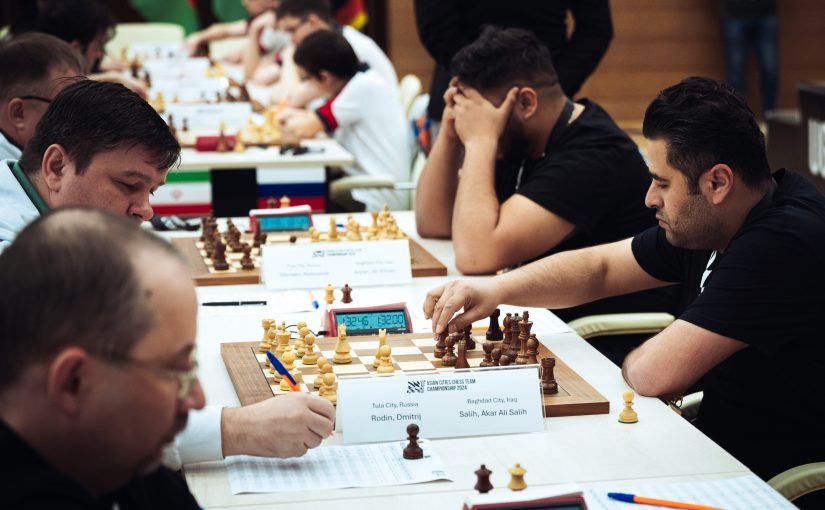
The Asian Cities Chess Team Championship finished in Khanty-Mansiysk.

The final 9th round was dramatic. In the match between the teams of Surgut and Pavlodar (Kazakhstan), Aleksei Pridorozhni confidently defeated Adil Tkachyov on the third table, but the positions of his teammates Ivan Bocharov and Nikolai Kabanov looked dangerous, and on the first board the game Iljiushenok – Malygin was relatively equal. Visit chess-results.com for round by round results and ranking.

In the meanwhile, the men’s team of Tehran (Iran) defeated Sukhbaatar (Mongolia) with a clean score and would have taken first place – if the Surgut team lost.

Eventually, Ilia Iljiushenok drew with Vladislav Malygin, Nikolai Kabanov achieved a draw in his game with Arystan Dosmukhambetov, so Ivan Bocharov’s loss to Asman Bayantas could no longer affect the outcome of the tournament.

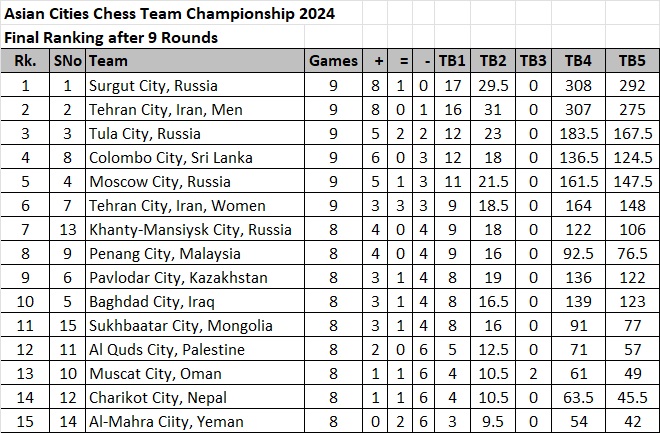
A draw in the match with Pavlodar allowed Surgut to take clear first place in the tournament, with 17 match points. Tehran came second with 16 points.

The teams of Tula and Colombo scored 12 points each. In the final round, the Russians defeated Al Quds (Palestine) with a score of 4:0, and the Sri Lanka chess players beat the Tehran women’s team with a minimal score.

A greater number of board points (23 versus 18) secured the third place for the Tula team.

Other results of the final round:

Moscow – Muscat (Oman) 3.5:0.5

Charikot (Nepal) – Penang (Malaysia) 0.5:3.5

Al Mahra (Yemen) – Khanty-Mansiysk 0.5:3.5

The team from Baghdad (Iraq) had a ‘bye’.


Final ranking of the teams:

  1. Surgut – 17 match points (29.5 board points)
  2. Tehran (men) – 16 (31)
  3. Tula – 12 (23),
  4. Colombo – 12 (18)
  5. Moscow – 11 (21.5)
  6. Tehran (women) – 9 (18.5)
  7. Khanty-Mansiysk – 9 (18)
  8. Penang – 9 (16)
  9. Pavlodar – 8 (19)
  10. Baghdad – 8 (16.5)
  11. Sukhbaatar – 8 (16)
  12. Al Quds – 5 (12.5)
  13. Muscat – 4 (10.5)
  14. Charikot – 4 (10.5)
  15. Al Mahra – 3 (9.5)

The best results on the boards were shown by:

1st board – Ilia Iljiushenok (Surgut)

2nd board – Ivan Bocharov (Surgut)

3rd board – Masoud Mosadeghpour (Tehran, men)

4th board – Abtin Atakhan (Tehran, men)

Surgut wins 8th Match at Asian Cities Chess Team Championship

The penultimate eighth round of the Asian Cities Chess Team Championship is completed in Khanty-Mansiysk.

The Surgut team defeated Sukhbaatar with a score of 4:0 thus winning an eighth match in a row.

Surgut captain Ilia Iljiushenok shared his impressions of his performance in the rounds played: “In terms of points, everything is excellent, but there are mistakes in games, so there is room for improvement. We had a key match in the third round with the team of Tehran (Iran), and after that the opponents are clearly weaker, so we are all gaining points. But despite this, fatigue growing, and matches are becoming more and more difficult.”

The Tehran men’s team defeated Khanty-Mansiysk with a score of 3.5:0.5. Bogdan Perchinsky managed to draw with tournament rating favorite Bardiya Daneshvar.

With the same score, the Tula squad beat Colombo (Sri Lanka) and has promoted to the third place.

The women’s team of Tehran crushed Baghdad (Iraq) with a score of 3:1, Moscow smashed Charikot (Nepal) with a clean score, Pavlodar (Kazakhstan) was stronger than Muscat (Oman) 4:0, and chess players from Al Quds (Palestine) defeated the athletes from Al Mahra (Yemen) 3:1.

The team of Penang (Malaysia) had a ‘bye’.

Before the last round, the Surgut team retains the lead with 16 match points scored. Tehran is 2 points behind. The teams of Tula (19 board points) and Colombo (15.5 board points) have 10 points each.

Round 9 pairings:
Surgut – Pavlodar
Tehran (men) – Sukhbaatar
Colombo – Tehran (women)
Tula – Al Quds
Moscow – Muscat
Charikot – Penang
Al Mahra – Khanty-Mansiysk
Baghdad – ‘bye’

The final 9th round will begin at 11:00 a.m. local time (09:00 Moscow time).

Surgut team wins seventh match in Asian Cities Team Championship

The games of the seventh round of the Asian Cities Chess Team Championship were played at the Ugra Chess Academy.

The Surgut team continues to gain points: this time the experienced team won against the junior team of Khanty-Mansiysk with a score of 3.5:0.5. Dinis Sattarov was close to defeating Aleksei Pridorozhni, but in time trouble, he was unable to break the grandmaster’s tough resistance.

In the Iranian derby, the Tehran men’s team defeated the women’s team with a clean score.

The Moscow team lost to chess players from Colombo (Sri Lanka) with a minimal score. Stanislav Khudyakov won on the first board, but G. Thilakarathne and R. Liyanage distinguished themselves on the second and third boards.

Tula chess players beat Penang (Malaysia) 3.5:0.5, the team of Sukhbaatar (Mongolia) beat Muscat (Oman) with a score of 3:1, and the team of Baghdad (Iraq) defeated Al Mahra with the same score (Yemen).

Charikot (Nepal) beat Al Quds (Palestine) with a score of 2.5:1.5. Quite quickly on the first board, Purushottam Chaulagain finished the game, defeating Ahmad Allazah with the black pieces, and spoke about his game:

– I knew that he would play 1. e4, and decided to go for the Sicilian Defense. But he preferred to play 2. d3, which was not the best opening. Nevertheless, White began an attack on the kingside, pushing f4 and g4, but I was ready for this. I think he made a mistake by playing f5 too early. This allowed me to take e5 with the queen. I was a pawn up and gradually managed to convert it I.

The Pavlodar (Kazakhstan) team had a ‘bye’.

The Surgut team retains its sole leadership two rounds before the finish: the “home team” has scored 14 match points. The Tehran men’s team is 2 points behind. The chess players from Colombo have 10 match points.

Round 8 pairings:

Sukhbaatar – Surgut
Khanty-Mansiysk – Tehran (men)
Tula – Colombo
Tehran (women) – Baghdad
Moscow – Charikot
Muscat – Pavlodar
Al Quds – Al Mahra
Penang – ‘bye’

Surgut Striding Ahead

IM Vladimir Barsky reviews Rounds 4–6 of the Asian Cities Team Championship

Surgut continues their winning stride in the Ugra Chess Academy. All members of the team have played many times within these walls, the academy surely feels like a home for them! However, in round 7, Surgut will face the real “home team,” young talents (born 2008–2011) from Khanty-Mansiysk. Youth or experience – what will prevail?

The leaders are closely chased by the Iranian men’s team. Tehran lost the face-to-face encounter and are 2 team points behind Surgut, but their sum of individual points is just 0.5 points less. These two strong teams will likely end up as winners and runners-up; meanwhile, at least four teams are competing for the bronze medal.

Another thing worth pointing out is the number of decisive games. Everyone plays boldly and enterprisingly, nobody shies away. Well, judge for yourselves.

Maxim Novikov (Tula, 2435) – Ivan Bocharov (Surgut, 2559)
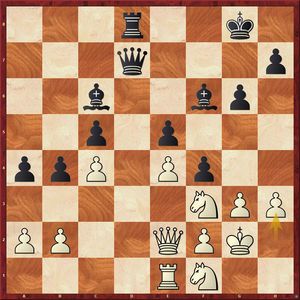
 

White didn’t play too well after the opening and gradually got a very unpleasant position. Black’s advantage is clear, but how can he achieve any progress?

31…Bb7! 32.Qc2 Bc8 33.g4 h5

Bocharov is starting to undermine the opponent’s kingside.

34.N1h2 Kf7 35.b3?!

It’s psychologically very hard to keep in your place and do nothing, waiting for the uninvited guests to arrive from some direction… But this exactly what White needed (for instance, 35.Kg1), because now white’s b3 pawn and the whole third rank is weak. Black immediately capitalizes on that.

35…Qd3! 36.Qb2

Even sadder is 36.Qxd3 Rxd3 37.Rb1 (37.bxa4 Ra3) 37…Bb7, and pawns start falling.

36…Qc3!

Bocharov insists on the queen trade, and absolutely correctly: it would be much easier for him to convert his advantage in the endgame.
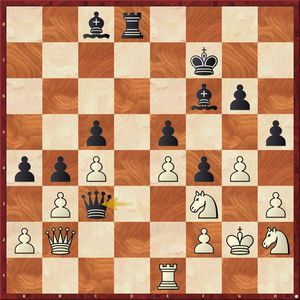
 

37.Qxc3

Meekly going along with the opponent’s wishes. More resilient was 37.Qb1, and it’s hard for Black to find a correct plan afterwards: 37…Bb7 (the trade 37…axb3 helps White to get rid of his weak а2 pawn) 38.g5 Bg7 39.Re2 Qd3! (but not 39…Rd3? 40.Rc2) 40.Qxd3 Rxd3 41.bxa4 (or immediately 41.Nd2 Rc3) 41…Rc3 42.Nd2 Rc2 – and the aforementioned weakness of the а2 pawn shows itself.

37…bxc3 38.Rc1 axb3 39.axb3 Bb7 40.Rxc3 Bxe4 41.Kf1 Bd3+ 42.Rxd3

Material losses are unavoidable (if 42.Kg2, then 42…e4); the rest is simple.

42…Rxd3 43.g5 Bg7 44.h4 e4 45.Ke2 Bc3 White resigned.


Aleksei Pridorozhni (Surgut, 2509) – Dmitrii Rodin (Tula)
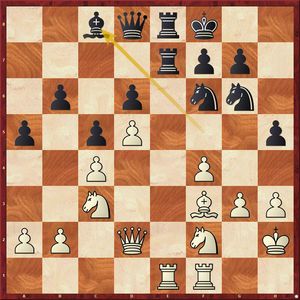
 

23.Re2

White has a small space advantage and prepares to clamp Black down. But he couldn’t push the pawn immediately: 23.g4? hxg4 24.hxg4 Rxe1 25.Rxe1 Nxg4+! 26.Bxg4 Qh4+ 27.Bh3 Rxe1 28.Qxe1 Bxh3 – black pieces break free and go on a rampage.

23…Rxe2 24.Bxe2 Ne7 25.g4 hxg4 26.hxg4 Ng6 27.g5 Ng8 28.Bd3 N8e7 29.Kg3

White is slowly going towards his goal, but his opponent’s defensive resources are far from exhausted.

29…Qd7 30.Re1 Nf5+ 31.Bxf5 Qxf5 32.Nce4 Qd7?!

Unnecessarily getting the queen away from the blockade square. Better was 32…Rd8, even though after, for instance, 33.Qe3 Re8 34.Qf3 Rd8 35.Rh1, White is still piling on the pressure.

33.f5! Ne7

Not 33…Qxf5? 34.Nxd6, but an exchange sacrifice 33…Rxe4!? 34.Rxe4 Qxf5 35.Qe3 Bd7 was worth considering.

34.f6 Nf5+ 35.Kh2 Nd4 36.Qf4 Qf5 37.Kg3

A solid move, but White missed a brilliant win here: 37.Qxd6+ Kg8 38.fxg7!!
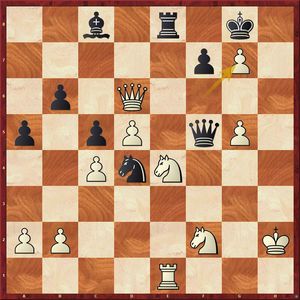
 

Black has a wide array of choices here, but they are all bleak:

1) 38…Kxg7 39.Qh6+ Kg8 40.Nf6+ Qxf6 41.Rxe8#;

2) 38…Nf3+ 39.Kg3 Nxe1 40.Nf6+ Kxg7 41.Nxe8+ Kg8 42.Nf6+ Kg7 43.Nh5+ Kg8 44.Qd8+ Kh7 45.Nf6+ Kg6 46.Qg8#;

3) 38…Qe5+ 39.Kg2! Qxd6 40.Nf6+! Perhaps the most beautiful move of the combination: instead of capturing the queen, the knight goes the other way. 40…Qxf6 (40…Kxg7 41.Nxe8+ Kg6 42.Nxd6) 41.Rxe8+ Kxg7 42.gxf6+ Kxf6 43.Rxc8, winning.

Of course, this is almost impossible to calculate, especially in time trouble.
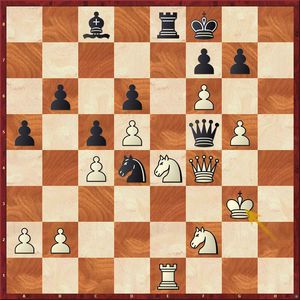
37…gxf6?

Much more resilient was 37…Kg8!, for instance: 38.Re3 (or 38.fxg7 Kxg7 39.Re3 Rd8) 38…Qe5 39.Qxe5 Rxe5 40.Nd3 Re8 41.Kf4 Nf5, and the battle is still going on.

38.Qxd6+ Kg7 39.Qxf6+ Kg8

No better was 39…Qxf6 40.gxf6+ Kg6 41.Kf4.

40.Rh1 (40.Nd6!) 40…Ne2+ 41.Kg2 Nf4+ 42.Kf1 Ng6 43.Qxf5 Bxf5 44.Nf6+ Kf8 45.Nxe8 Kxe8 46.Ke2 Ke7 47.Ke3 Kd6 48.b3 Ne7 Black resigned.


Kosala Sandeepa Chamkara Amarathunga (Colombo, 1772) –
Bardiya Daneshvar (Tehran, 2584)
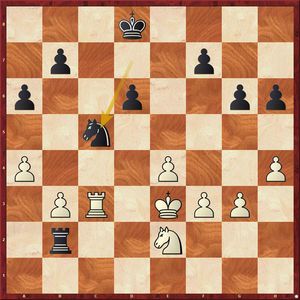
 

This game shows how great was the general progress of chess players. The Iranian grandmaster only managed to defeat his opponent, whose Elo rating was 800 (!) points lower, after a great struggle.

45.Nc1

Too passive. After 45.Nd4, White would have been all right.

45…b6 46.Kf4

And here, he should have used the unexpected tactical opportunity: 46.e5!? dxe5 47.a5, with good chances for a favourable result.

46…a5 47.Ke3

But now 47.e5 d5 48.Ke3 Ke7 achieves nothing.

47…h5 48.Kd4 Rg2 49.f4 Rg1!

Creating the threat 50…Rxc1 51.Rxc1 Nxb3+.

50.Ne2

50.Kd5 Kd7 51.Ne2 Rd1+ 52.Nd4 Ne6 53.Rc4 Nc7+ loses.

50…Rb1 51.Nc1?

Surprisingly, White, having just defended from a petite combination, again made it possible… After 51.Kd5 Nxb3 52.Kxd6 Nc5 53.Ra3, White could still fight for a draw.

51…Rxc1! White resigned.


Seyed Kian Poormousavi (Tehran) – K K Dinujaya Kodithuwakku (Colombo, 1707)
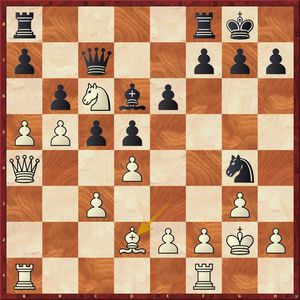
 

White has the initiative, and after the approximate 22…Nf6 23.axb6 Qxb6 (23…axb6 loses to 24.Qxa8 Rxa8 25.Rxa8+ Bf8 26.dxc5 bxc5 27.Rfa1) 24.f3, a difficult defence awaits Black. He tried to eliminate the opponent’s queenside pressure, and that’s what came out of that.

22…a6? 23.axb6 Qxb6 24.dxc5

Funny enough, the computer considers 24.Rfb1 to be even stronger. But how can you not just capture a knight?

24…Bxc5 25.Qxg4

“Hanging pieces fall,” Grandmaster John Nunn wrote completely correctly in his great book Secrets of Practical Chess. Black resigned 10 moves later.


Govinda Man Shrestha (Katmandu, 1738) –
Arystan Dosmukhambetov (Pavlodar, 1968)
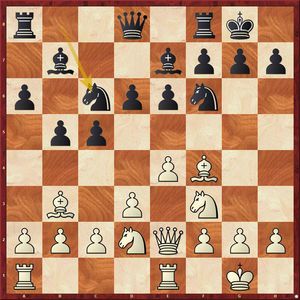
 

White’s position might not be better, but it’s certainly not worse. However, he suddenly decided to play a little combination – and paid dearly for it.

11.Bxd6?

After, say, 11.c3 h6 12.a4 Qc7, everything is only beginning.

11…Bxd6 12.e5 Bxe5 13.Nxe5 Nxe5 14.Qxe5 c4!

The bishop gets trapped – literally out of nowhere.

15.Nxc4

Or 15.dxc4 Qxd2 – a knight is also a good piece.

15…bxc4 16.Bxc4 Qb6 17.h3 Qc6

Two pawns are not an adequate compensation for the knight; moreover, Black now firmly seizes the initiative.

18.f3 Rac8 19.a3 Qb6+ 20.Qe3 Qd6 21.Qe5 Qe7 22.c3 Rc5 23.Qe2 Rg5 24.d4 Nh5 25.Kf2 Nf4 26.Qf1 Rxg2+ 27.Ke3 Qg5 28.Rad1 Nxh3+ 29.Kd3 Nf2+ White resigned.


Ivan Bocharov (Surgut, 2559) – Pavra Behzad Nazif (Tehran, women, 2125)
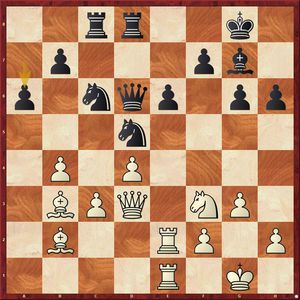
 

The Iranian player played very well in the opening and got a good play, but then she fell for a small provocation.

25.h4!? h5?

By no means Black should have weakened the g5 square! After 25…b5 26.h5 gxh5 27.Bc2 Qc7 28.Qh7+ Kf8, there was a sharp struggle for three results.

26.Ng5 Nc7

26…Qf8 is also well met with 27.Nxe6! fxe6 28.Qxg6 Qf3 29.Rxe6.
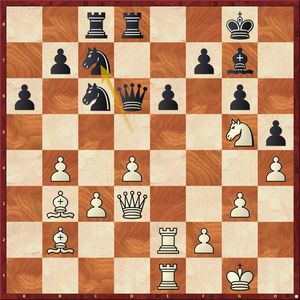
 

27.Nxe6! Nxe6 28.Rxe6 Qc7

Or 28…fxe6 29.Qxg6! Re8 30.Rxe6 Rxe6 31.Bxe6+ Kh8 32.Qxh5+ with quite an economical mate.

With the game move, Black places a small trap, and White gladly “falls” for it.

29.Rxg6 Ne5 30.Rxe5! Qxe5 31.Bxf7+! Kxf7 32.Qf3+ Kxg6 33.dxe5 Bxe5 34.Qxb7

White has a queen and three pawns for two rooks, but, what’s even more important, the black king is completely exposed.

34…Rd1+ 35.Kg2 Rcd8 36.Qxa6+ R8d6 37.Qe2 Bf6 38.c4 Bxb2 39.Qxb2 R1d2 40.Qe5 Black resigned.


Baha Miswadah (Al Quds, 1986) – Yuan Hui Yeoh (Penang, 1894)
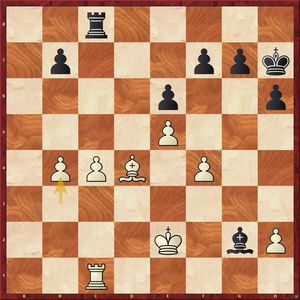
 

There’s likely no serious threats for Black. Of course, the king cannot go to f5 immediately (28…Kg6? 29.Rg1), but why not 28…Ra8 or 28…g5? However, the Malaysian player decided to play more “solidly”: force the opponent to put all his pawns on the dark squares and provide his bishop with an excellent central square. But there was one small detail…

28…Bd5? 29.cxd5!

This is the detail! Nobody cares about the exchange when the pawn is going to promote!

29…Rxc1 30.d6 Rc8 31.Bb6 Rc6 32.d7 Rxb6 33.d8Q Rxb4

An attempt to build a fortress, but White has enough resources to break through the opponent’s defence. The first part of the plan is to activate the king and capture the b7 pawn (to avoid possible future distractions).

34.Qd2 Rb6 35.Qc2+ g6 36.h4 h5 37.Qc7 Rb2+ 38.Kd3 Kg7 39.Qe7 Rg2

After 39…Rb1, the decisive move is 40.f5 gxf5 41.Qg5+.

40.Kc4 Rc2+ 41.Kd4 Rf2 42.Qf6+ Kg8 43.Kc5 Rd2 44.Qe7 Rf2 45.Qd8+ Kg7 46.Qf6+ Kf8 47.Kb6 Rb2+ 48.Kc7 Rc2+

Black has to give up the pawn due to 48…b5? 49.Qh8+ Ke7 50.Qd8#.

49.Kxb7 Rb2+ 50.Kc6 Rc2+ 51.Kb5 Rf2 52.Qd8+ Kg7 53.Qd4 Rc2 54.Qd3 Rc1 55.Qd2 Rc8 56.Qd4 Rc1 57.Kb6 Rc2

White is ready for the finishing onslaught…
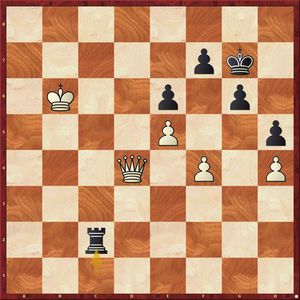
58.f5! gxf5

Or 58…exf5 59.e6+ Kf8 60.Qf6.

59.Qg1+ Kf8 60.Qg5 Rc4 61.Qxh5 Rg4 62.Qh8+ Rg8 63.Qh6+ Rg7 64.h5 Kg8 65.Kc6 Rh7 66.Qg5+ Rg7 67.Qd8+ Kh7 68.Qf6 Kg8 69.Kd6 f4 70.Qxf4 Kh7 71.Qf6 Kg8 72.Ke7 Black resigned.


Daniil Manelyuk (Tula, 2267) – Sina Movahed (Tehran, 2463)
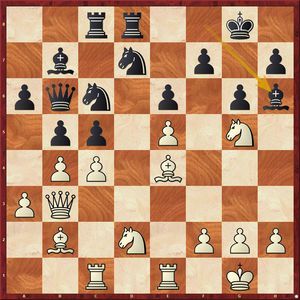
 

An impressive battle: not mistake-free, but very exciting!

23.Nxe6!?

Of course, 23.h4 was more cautious, but we wouldn’t have seen all the subsequent adventures otherwise.

23…Bxd2 24.cxb5 Bxe1

24…axb5 25.Nxd8 Nxd8 26.Bxb7 Qxb7 27.e6 fxe6 28.Rxe6 c4! refuted White’s idea, closing off the dangerous diagonal just in time.

25.bxc6 Bxf2+

Black could pose more problems for White with 25…Bxc6 26.Nxd8 c4, but even here, he should save the game: 27.Qf3 (but not 27.Qxc4? Qxf2+ 28.Kh1 Bxe4) 27…Qxf2+ 28.Qxf2 Bxf2+ 29.Kxf2 Bxe4 30.e6 Rxd8 31.exd7 Bd5 32.Re1! Kf8 (32…Rxd7?? 33.Re8#) 33.Re8+ Rxe8 34.dxe8Q+ Kxe8 with the drawn opposite-colored bishop endgame.

26.Kxf2 c4+ 27.Qe3 fxe6?

27…Bxc6 28.Nxd8 Bxe4 29.Bd4 Qxd8 30.Qxe4 Nf8 led to a quiet, roughly equal position.

28.Bd4 Qb5 29.cxb7 Rc7 30.Kg1 Rb8 31.Qf3?!

31.Qg3! maintained the advantage

31…a5 32.Rb1 c3 33.Bxc3 Qc4?

Black had a beautiful way to a perpetual-check draw: 33…Nc5! 34.bxc5 Qxc5+ 35.Qf2 Qxc3 36.Qa7 Kg7 37.Qxb8 (37.h3 Qc5+) 37…Qc5+ 38.Kf1 (38.Kh1? Qc1+) 38…Qc4+ 39.Kf2 Qd4+ 40.Kf1 Qc4+ etc.

34.Rd1? 

Both players were apparently in time trouble. 34.Rc1 solidified White’s advantage, but he could have lost after the game move.
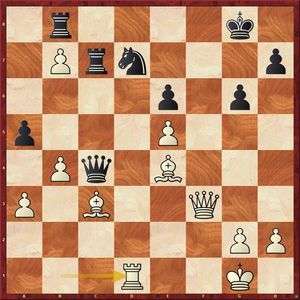
34…Nf8?

Black missed a strong intermediate move that created mating threats. After 34…Rf8! 35.Qe3 Qxc3 36.Qxc3 Rxc3, White cannot capture the knight 37.Rxd7 due to 37…Rc1+, so he just loses a piece.

35.Bd4 Rf7 36.Qd3 Qc7 37.bxa5 Qxa5 38.Qb3 Rd7 39.Qb4 Qa6 40.Rf1 Qe2 41.Bc6 Rf7 42.Rxf7 Kxf7 43.h3 Rd8 44.Bf3 Qd3 45.Bb6 Re8 46.Bc7 Nd7 47.Bc6 Qe3+ 48.Kh2 Rd8 49.Bxd7 Black resigned.


Masoud Mosadeghpour (Tehran, 2436) – Maxim Novikov (Tula, 2435)
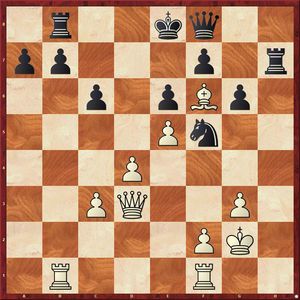
Black has an extra pawn, but his pieces are poorly coordinated: the rook is stuck on h7, the king is on e8. And all dark squares are hopelessly weak…

24.Qa6! Qh6

Both 24…bxa6 25.Rxb8+ Kd7 26.Rxf8 and 24…b6 25.Qxa7 loses. Black tries to create counterplay along the h-file, but the white king escapes the pursuit rather easily.

25.Rxb7 Qh3+ 26.Kf3 Qh5+ 27.Kf4

Another good move was 27.g4 Qh3+ 28.Ke2 Qxg4+ 29.f3 Qg2+ (29…Rh2+ 30.Kd3) 30.Rf2 Ng3+ 31.Kd3, winning.

27…g5+ 28.Ke4 Qg4+ 29.Kd3 Qf3+ 30.Kd2 Rd8 31.Qa5 Rc8 32.Qc5 Rh2 33.Re7+ Kf8 34.Rc7+ Black resigned.


Marat Gilfanov (Moscow, 2080) – Anahita Zahedifar (Tehran, women, 1991)

Today’s last example is somewhat similar to the previous one.
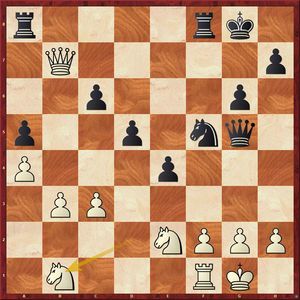
 

26…Ne3!

Another jump to a square that looks well-defended by the pawn! The lines are very simple, so White resigned immediately.
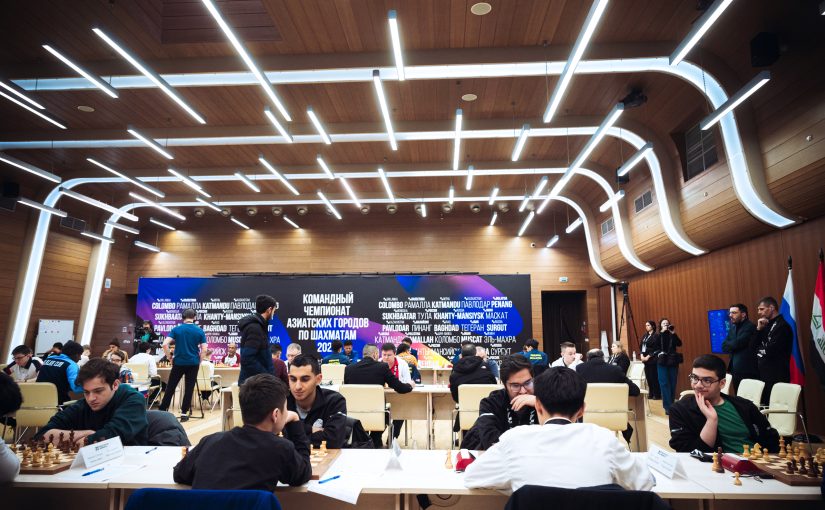
 

Two thirds of the Asian Cities Chess Team Championship played in Khanty-Mansiysk

Surgut retains its leadership

The sixth round of the Asian Cities Team Championship has been completed at the Ugra Chess Academy.

The leader of the race, the Surgut team, defeated Penang (Malaysia) with a clean score.

At the second table, the Tehran men’s team defeated Tula with a score of 3:1. Only Sina Movahed stumbled, losing to Daniil Manelyuk with black on the first table.

The match between Moscow and Tehran (women) ended in a draw. In the Russian team, Dmitry Kirillov and Mikhail Kuznetsov achieved victories; in the Iranian squad, Melika Mohammadi and Anahita Zahedifar distinguished themselves.

Dmitry Kirillov spoke a little about his game: “The game developed very easily. I did not expect 1…e5 and the Russian game as a whole. But it appeared on the board, I played according to old analyzes that I didn’t even fully remember. But nevertheless less very quickly got well and, one might say, won without effort.”

The Colombo team (Sri Lanka) won against Baghdad (Iraq) with a minimal score. The decisive victory was the victory of international master Ranindu Llanage on the third board. The athlete noted that the game was not easy.

“I got the advantage from the opening, but he defended very well. I only managed to win in the end. Then the score in the match was 1.5:1.5, so thanks to this we were able to win.”

The Khanty-Mansiysk team beat Pavlodar (Kazakhstan) with a score of 2.5:1.5. Bogdan Perchinsky and Dinis Sattarov brought success to the team.

Sukhbaatar (Mongolia) defeated Al-Quds (Palestine) 2.5:1.5, and Muscat (Oman) defeated Charikot (Nepal) with the same result.

The day off was the El Mahra team (Yemen).

Pairs of the 7th round:
Surgut – Khanty-Mansiysk
Tehran (men) – Tehran (women)
Colombo – Moscow
Penang – Tula
Muscat – Sukhbaatar
El Mahra – Baghdad
Al-Quds – Charikot
Day off – Pavlodar

The Surgut team wins another match at the Asian Cities Chess Team Championship

The fifth round of the Asian Cities Team Championship has been completed at the Ugra Chess Academy.

And this match day didn’t bring any sensation: the Surgut team defeated the women’s team of Tehran (Iran) with a score of 3:1. Ilia Iljiushenok and Ivan Bocharov won their games, Mohammadi – Pridorozhni and Kabanov – Asgharzadeh played to a draw.

The Tehran men’s team left no chance to team Moscow, winning with a score of 3.5:0.5. Vasilii Titarov made a draw with Abtin Atakhan.

The match between Tula and Baghdad ended in a draw: the win of the Iraqi master Hussein Ali Hussein Al-Ali was offset by the victory of the Russian Dmitrij Rodin.

Athletes from Colombo (Sri Lanka) beat Pavlodar (Kazakhstan) with a minimal score. Chess players from Penang (Malaysia) defeated Al Quds (Palestine) with a score of 3:1.

Malaysian team member Looi Xin Hao briefly commented on his game: “It turned out to be a fine game. We played the accepted Queen’s Gambit Accepted. I think I misplayed somewhere, trading queens. I probably should have kept them. But in any case, tactically, the opponent did not find a strike in the middlegame, after which I regained control of the position and managed to convert into a better ending.”

The youth team of Khanty-Mansiysk literally crushed Charikot (Nepal), winning the match with a score of 3.5:0.5. Bogdan Perchinsky, Dinis Sattarov and Aleksandr Machankin brought points to their team.

The leader of the Ugra team, Bogdan Perchinsky, says: “In my opinion, the fight was quite easy for me. My opponent chose a rare scheme and made a mistake in the opening. Not only did I get an advantage in development, but I also won material. Then my advantage only increased, and in the end, I managed to bring the game to a victory.”

The Sukhbaatar team (Mongolia) won with a clean score against Al Mahra (Yemen).

The Surgut team is in the lead with 10 match points, having won all the matches. The Tehran men’s team is 2 points behind.


Round 6 pairings:

Surgut – Penang

Tula – Tehran (men)

Moscow – Tehran (women)

Baghdad – Colombo

Pavlodar – Khanty-Mansiysk

Sukhbaatar – Al Quds

Charikot – Muscat

Al Mahra – bye

Join HKD 250,000 Asian Rapid Chess Team Championship

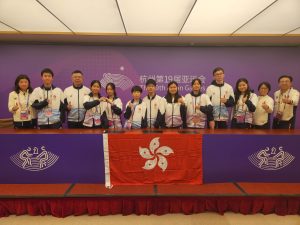
The Hong Kong China Chess Federation Limited (HKCFL) is honoured to invite chess players from all member federations of the Asian Chess Federation to participate in the Asian Rapid Chess Team Championship 2024 (FIDE rated) from the 21st August 2024 (arrival) to the 25th August 2024 (departure). At right with Hong Kong players is Hong Kong China Chess Federation president K.K. Chan.

Download Asian Rapid Team 2024 Regulations Final

Asian Seniors 50+ and 65+ Chess Championships in Mongolia

The Mongolian Chess Federation in cooperation with the City of Ulaanbaatar under the auspices of the
Asian Chess Federation and International Chess Federation and Mongolian National Olympic
Committee, has the honour to invite all National Chess Federations in Asia to participate in the 2024
Asian Seniors Chess Championships for over 50 and over 65 years old (and best women), from 9-19
August 2024 at the Terelj World Resort Ulaanbaatar, Mongolia.

Download Asian Senior Chess Championships 2024 regulations Final

Download Registration_Form_Asian_Seniors_Chess_Championships_2024

Joseph Galindo Sweeps IIEE Chess Tournament in Dubai

Engr. Joseph HajiYusuf Riano Villanueva Galindo swept his assignments and scored 7.0 points to rule the just concluded over-the-board IIEE UAE mini-chess tournament held last April 20, 2024.= at the Flamingo Dubai, United Arab Emirates.

Engr. Danilo “Danny” Reyes wound up second with 5.0 points. At third place is IIEE National Past President Engr. Allan Anthony Alvarez with similar 5.0 points. Former World Open Under 2200 section champion Rocky Pabalan took solo fourth with 4.0 points. The first two games were played by former chapter president Ernie Vergosa.

Joint 5th with 3.0 points are Meinard Andres and Former chapter president Melchor de Roma.
The IIEE UAE chess team was also awarded with ther plaque and medals for their championship in group B of the Philippine Technological Council’s World Engineering day chess online tournament held January 26 to March 22, 2024.
Top scorer was Jorex JC Colmo and the following had scored at least 10 points for the 5 games are AGM Galindo, Marvin Marcos, Rolly Gangozo, Jerson Bitoon, Cheran Bartolata and Michael Linde.
Meanwhile in billiards, Norberto Lingcaso Jr. captured the crown with Joel Penaflor, Meinard Andres and former chapter President Jun Legayada placing 2nd to 4th, respectively.  Next events are badminton on April 28 and basketball which will be held from May 12 to June 9, 2024.  The IIEE UAE is led by its lady chapter president Melanie Rances.-Marlon Bernardino-